Tehrangeles Vice (Iranian Diaspora Pop 1983-1993)
[[Release Detail]][[Release Description]]
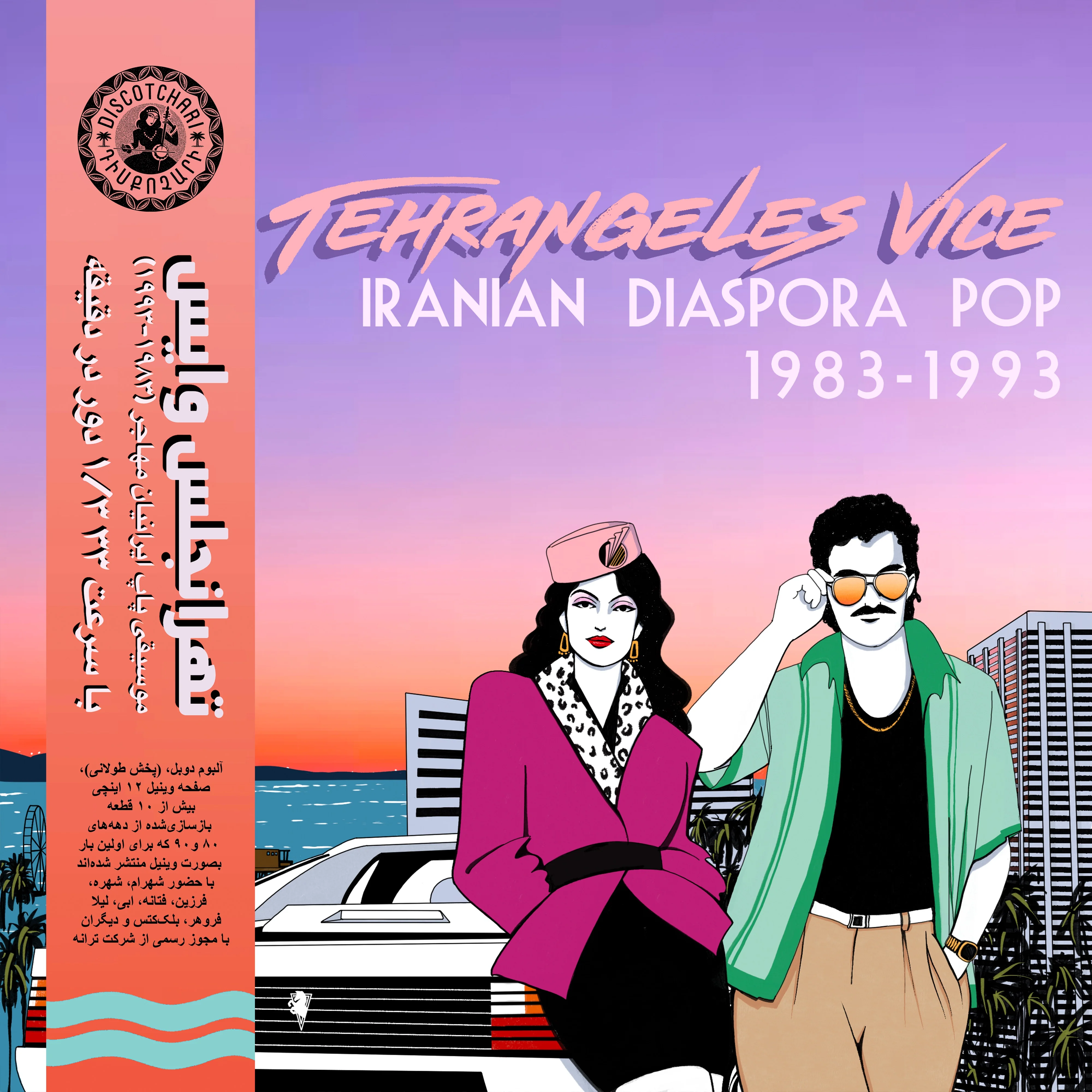
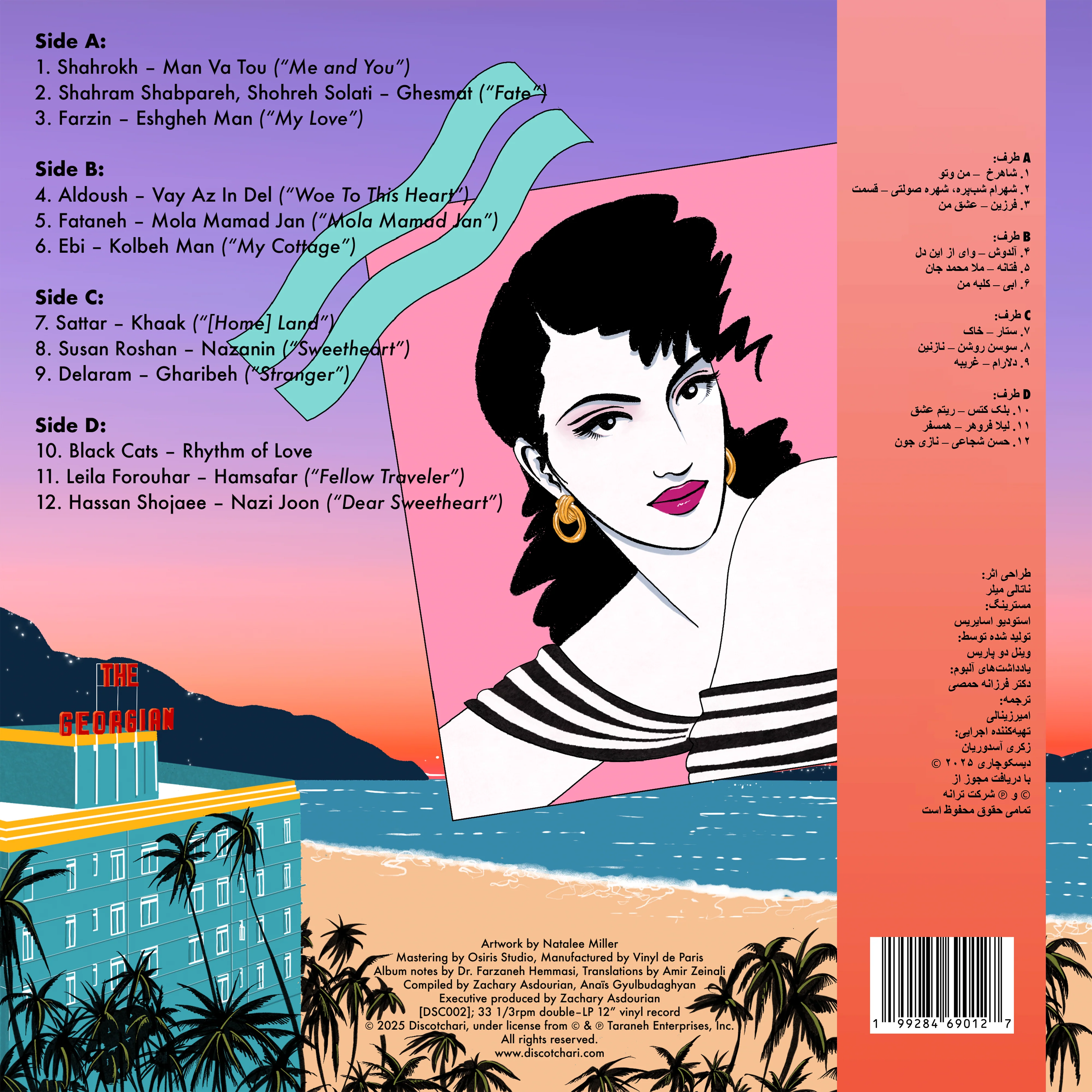
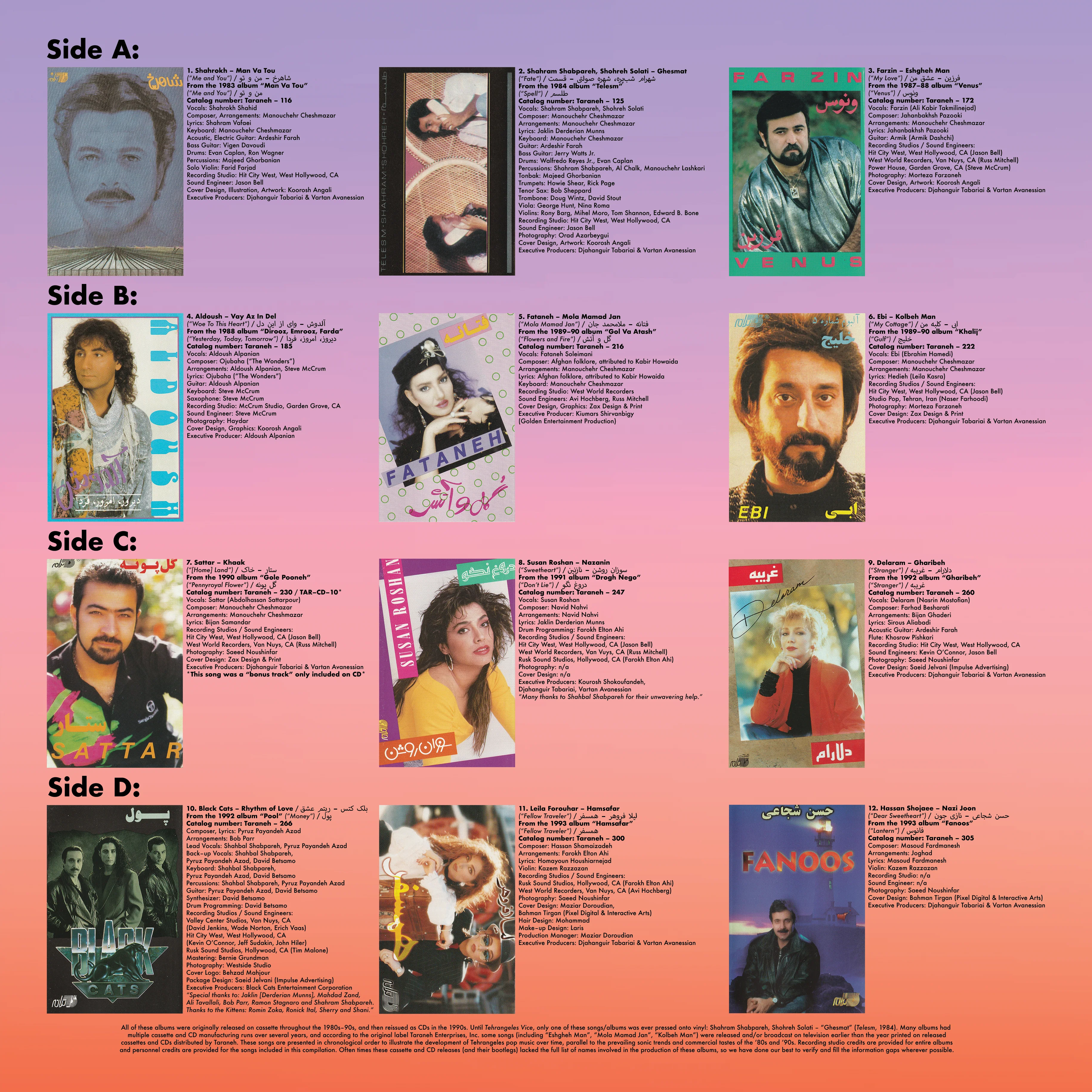
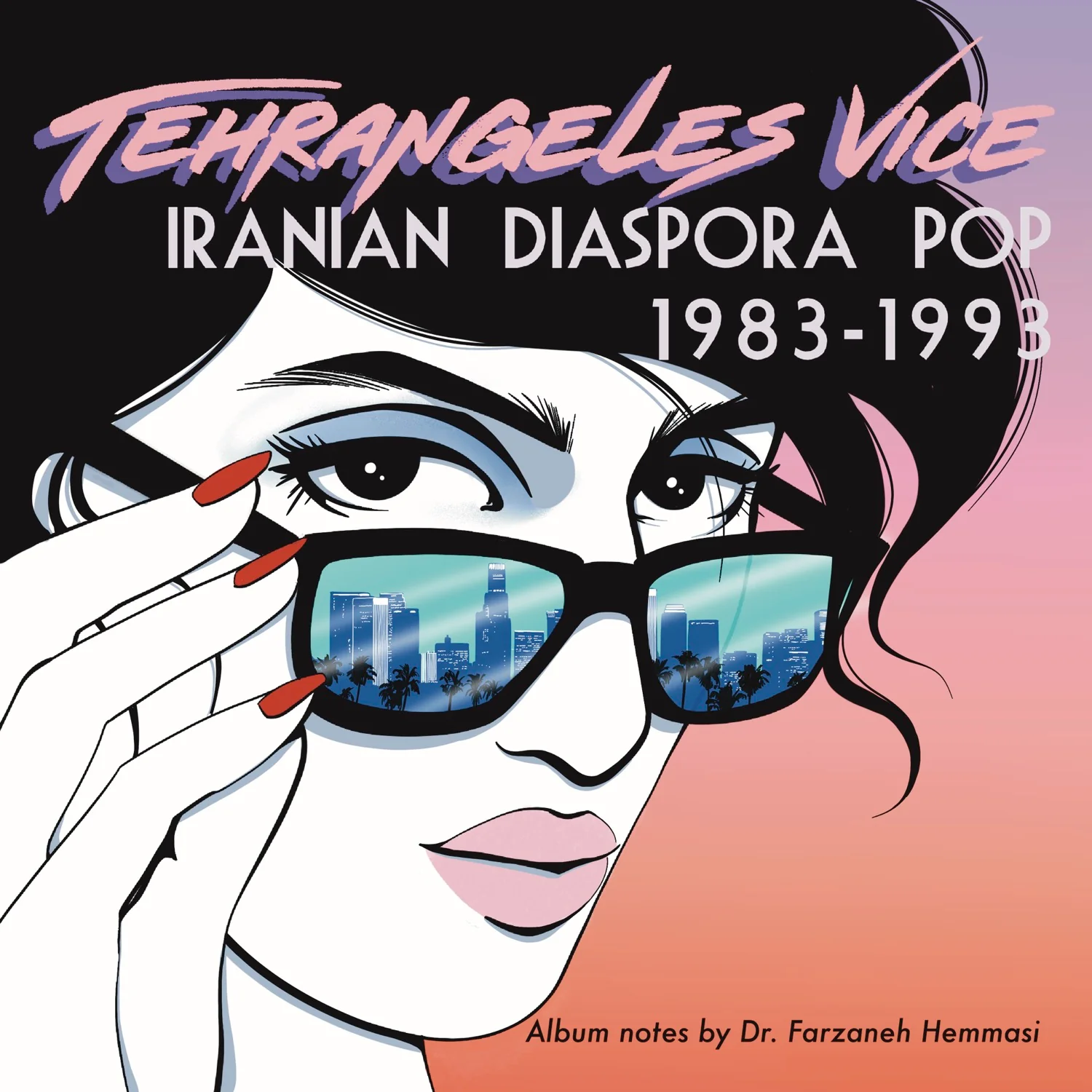
Discotchari is delighted to release a first-of-its-kind various artists compilation: Tehrangeles Vice (Iranian Diaspora Pop 1983–1993), fully licensed from Taraneh Enterprises. The album is a groundbreaking exposé of the vibrant subcultural hub of Tehrangeles (portmanteau of Tehran + Los Angeles), and the action–packed, true story of the Iranian diaspora music industry. Featuring 12 tracks remastered by award–winning Osiris Studio, lyrics and translations to all featured songs, original cassette covers, a 20+ page album note booklet by Dr. Farzaneh Hemmasi and more!
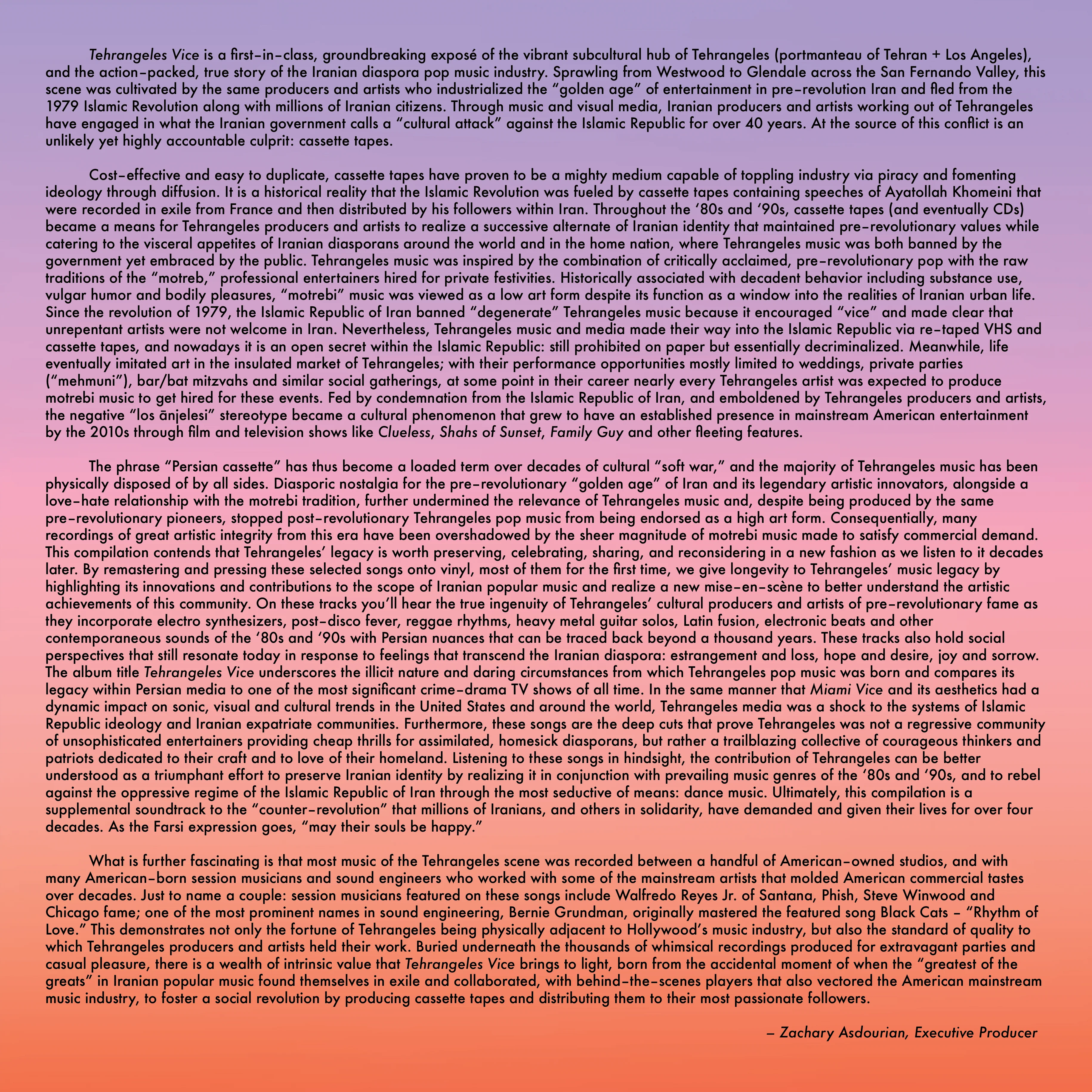
"Sprawling from Westwood to Glendale across the San Fernando Valley, this scene was cultivated by the same producers and artists who industrialized the “golden age” of entertainment in pre–revolution Iran and fled from the 1979 Islamic Revolution along with millions of Iranian citizens. Through music and visual media, Iranian producers and artists working out of Tehrangeles have engaged in what the Iranian government calls a “cultural attack” against the Islamic Republic for over 40 years. At the source of this conflict is an unlikely yet highly accountable culprit: cassette tapes.
Cost–effective and easy to duplicate, cassette tapes have proven to be a mighty medium capable of toppling industry via piracy and fomenting ideology through diffusion. It is a historical reality that the Islamic Revolution was fueled by cassette tapes containing speeches of Ayatollah Khomeini that were recorded in exile from France and then distributed by his followers within Iran. Throughout the ‘80s and ‘90s, cassette tapes (and eventually CDs) became a means for Tehrangeles producers and artists to realize a successive alternate of Iranian identity that maintained pre–revolutionary values while catering to the visceral appetites of Iranian diasporans around the world and in the home nation, where Tehrangeles music was both banned by the government yet embraced by the public. Tehrangeles music was inspired by the combination of critically acclaimed, pre–revolutionary pop with the raw traditions of the “motreb,” professional entertainers hired for private festivities. Historically associated with decadent behavior including substance use, vulgar humor and bodily pleasures, “motrebi” music was viewed as a low art form despite its function as a window into the realities of Iranian urban life. Since the revolution of 1979, the Islamic Republic of Iran banned “degenerate” Tehrangeles music because it encouraged “vice” and made clear that unrepentant artists were not welcome in Iran. Nevertheless, Tehrangeles music and media made their way into the Islamic Republic via re–taped VHS and cassette tapes, and nowadays it is an open secret within the Islamic Republic: still prohibited on paper but essentially decriminalized. Meanwhile, life eventually imitated art in the insulated market of Tehrangeles; with their performance opportunities mostly limited to weddings, private parties (“mehmuni”), bar/bat mitzvahs and similar social gatherings, at some point in their career nearly every Tehrangeles artist was expected to produce motrebi music to get hired for these events. Fed by condemnation from the Islamic Republic of Iran, and emboldened by Tehrangeles producers and artists, the negative “los ānjelesi” stereotype became a cultural phenomenon that grew to have an established presence in mainstream American entertainment by the 2010s through film and television shows like Clueless, Shahs of Sunset, Family Guy and other fleeting features.
The phrase “Persian cassette” has thus become a loaded term over decades of cultural “soft war,” and the majority of Tehrangeles music has been physically disposed of by all sides. Diasporic nostalgia for the pre–revolutionary “golden age” of Iran and its legendary artistic innovators, alongside a love–hate relationship with the motrebi tradition, further undermined the relevance of Tehrangeles music and, despite being produced by the same pre–revolutionary pioneers, stopped post–revolutionary Tehrangeles pop music from being endorsed as a high art form. Consequentially, many recordings of great artistic integrity from this era have been overshadowed by the sheer magnitude of motrebi music made to satisfy commercial demand. This compilation contends that Tehrangeles’ legacy is worth preserving, celebrating, sharing, and reconsidering in a new fashion as we listen to it decades later. By remastering and pressing these selected songs onto vinyl, most of them for the first time, we give longevity to Tehrangeles’ music legacy by highlighting its innovations and contributions to the scope of Iranian popular music and realize a new mise–en–scène to better understand the artistic achievements of this community. On these tracks you’ll hear the true ingenuity of Tehrangeles’ cultural producers and artists of pre–revolutionary fame as they incorporate electro synthesizers, post–disco fever, reggae rhythms, heavy metal guitar solos, Latin fusion, electronic beats and other contemporaneous sounds of the ‘80s and ‘90s with Persian nuances that can be traced back beyond a thousand years. These tracks also hold social perspectives that still resonate today in response to feelings that transcend the Iranian diaspora: estrangement and loss, hope and desire, joy and sorrow. The album title Tehrangeles Vice underscores the illicit nature and daring circumstances from which Tehrangeles pop music was born and compares its legacy within Persian media to one of the most significant crime–drama TV shows of all time. In the same manner that Miami Vice and its aesthetics had a dynamic impact on sonic, visual and cultural trends in the United States and around the world, Tehrangeles media was a shock to the systems of Islamic Republic ideology and Iranian expatriate communities. Furthermore, these songs are the deep cuts that prove Tehrangeles was not a regressive community of unsophisticated entertainers providing cheap thrills for assimilated, homesick diasporans, but rather a trailblazing collective of courageous thinkers and patriots dedicated to their craft and to love of their homeland. Listening to these songs in hindsight, the contribution of Tehrangeles can be better understood as a triumphant effort to preserve Iranian identity by realizing it in conjunction with prevailing music genres of the ‘80s and ‘90s, and to rebel against the oppressive regime of the Islamic Republic of Iran through the most seductive of means: dance music. Ultimately, this compilation is a supplemental soundtrack to the “counter–revolution” that millions of Iranians, and others in solidarity, have demanded and given their lives for over four decades. As the Farsi expression goes, “may their souls be happy.”
What is further fascinating is that most music of the Tehrangeles scene was recorded between a handful of American–owned studios, and with many American–born session musicians and sound engineers who worked with some of the mainstream artists that molded American commercial tastes over decades. Just to name a couple: session musicians featured on these songs include Walfredo Reyes Jr. of Santana, Phish, Steve Winwood and Chicago fame; one of the most prominent names in sound engineering, Bernie Grundman, originally mastered the featured song Black Cats – “Rhythm of Love.” This demonstrates not only the fortune of Tehrangeles being physically adjacent to Hollywood’s music industry, but also the standard of quality to which Tehrangeles producers and artists held their work. Buried underneath the thousands of whimsical recordings produced for extravagant parties and casual pleasure, there is a wealth of intrinsic value that Tehrangeles Vice brings to light, born from the accidental moment of when the “greatest of the greats” in Iranian popular music found themselves in exile, and collaborated with behind–the–scenes players that also vectored the mainstream music industry, to foster a social revolution by producing cassette tapes and distributing them to their most passionate followers.”
– Zachary Asdourian, Executive Producer
[[Selling Points]]
- 12 tracks fully licensed from Taraneh Enterprises, Inc. and remastered by award-winning Osiris Studio, 11 of which are now available on vinyl for the first time!
- Groundbreaking exposé into the post-revolution Iranian music instead of pre-revolution, which has been highlighted (and bootlegged) many times.
- Packaged with 20+ page album note booklet with historical analysis from leading Tehrangeles ethnomusicologist from the University of Toronto, Dr. Farzaneh Hemmasi.
- Comes with “lyric sheet” inner sleeves written in Farsi with English translations. Wants to learn Farsi? These lyric sheets also include Latin-alphabet transliterations of the Farsi lyrics!
- Album also comes with obi sleeve, download card, scans of original cassette covers, and music you have to hear to believe.
[[Catalog Number]]DSC002[[Artist]]Various Artists
Original: $40.00
-70%$40.00
$12.00Product Information
Product Information
Shipping & Returns
Shipping & Returns
Description
[[Release Detail]][[Release Description]]
Discotchari is delighted to release a first-of-its-kind various artists compilation: Tehrangeles Vice (Iranian Diaspora Pop 1983–1993), fully licensed from Taraneh Enterprises. The album is a groundbreaking exposé of the vibrant subcultural hub of Tehrangeles (portmanteau of Tehran + Los Angeles), and the action–packed, true story of the Iranian diaspora music industry. Featuring 12 tracks remastered by award–winning Osiris Studio, lyrics and translations to all featured songs, original cassette covers, a 20+ page album note booklet by Dr. Farzaneh Hemmasi and more!
"Sprawling from Westwood to Glendale across the San Fernando Valley, this scene was cultivated by the same producers and artists who industrialized the “golden age” of entertainment in pre–revolution Iran and fled from the 1979 Islamic Revolution along with millions of Iranian citizens. Through music and visual media, Iranian producers and artists working out of Tehrangeles have engaged in what the Iranian government calls a “cultural attack” against the Islamic Republic for over 40 years. At the source of this conflict is an unlikely yet highly accountable culprit: cassette tapes.
Cost–effective and easy to duplicate, cassette tapes have proven to be a mighty medium capable of toppling industry via piracy and fomenting ideology through diffusion. It is a historical reality that the Islamic Revolution was fueled by cassette tapes containing speeches of Ayatollah Khomeini that were recorded in exile from France and then distributed by his followers within Iran. Throughout the ‘80s and ‘90s, cassette tapes (and eventually CDs) became a means for Tehrangeles producers and artists to realize a successive alternate of Iranian identity that maintained pre–revolutionary values while catering to the visceral appetites of Iranian diasporans around the world and in the home nation, where Tehrangeles music was both banned by the government yet embraced by the public. Tehrangeles music was inspired by the combination of critically acclaimed, pre–revolutionary pop with the raw traditions of the “motreb,” professional entertainers hired for private festivities. Historically associated with decadent behavior including substance use, vulgar humor and bodily pleasures, “motrebi” music was viewed as a low art form despite its function as a window into the realities of Iranian urban life. Since the revolution of 1979, the Islamic Republic of Iran banned “degenerate” Tehrangeles music because it encouraged “vice” and made clear that unrepentant artists were not welcome in Iran. Nevertheless, Tehrangeles music and media made their way into the Islamic Republic via re–taped VHS and cassette tapes, and nowadays it is an open secret within the Islamic Republic: still prohibited on paper but essentially decriminalized. Meanwhile, life eventually imitated art in the insulated market of Tehrangeles; with their performance opportunities mostly limited to weddings, private parties (“mehmuni”), bar/bat mitzvahs and similar social gatherings, at some point in their career nearly every Tehrangeles artist was expected to produce motrebi music to get hired for these events. Fed by condemnation from the Islamic Republic of Iran, and emboldened by Tehrangeles producers and artists, the negative “los ānjelesi” stereotype became a cultural phenomenon that grew to have an established presence in mainstream American entertainment by the 2010s through film and television shows like Clueless, Shahs of Sunset, Family Guy and other fleeting features.
The phrase “Persian cassette” has thus become a loaded term over decades of cultural “soft war,” and the majority of Tehrangeles music has been physically disposed of by all sides. Diasporic nostalgia for the pre–revolutionary “golden age” of Iran and its legendary artistic innovators, alongside a love–hate relationship with the motrebi tradition, further undermined the relevance of Tehrangeles music and, despite being produced by the same pre–revolutionary pioneers, stopped post–revolutionary Tehrangeles pop music from being endorsed as a high art form. Consequentially, many recordings of great artistic integrity from this era have been overshadowed by the sheer magnitude of motrebi music made to satisfy commercial demand. This compilation contends that Tehrangeles’ legacy is worth preserving, celebrating, sharing, and reconsidering in a new fashion as we listen to it decades later. By remastering and pressing these selected songs onto vinyl, most of them for the first time, we give longevity to Tehrangeles’ music legacy by highlighting its innovations and contributions to the scope of Iranian popular music and realize a new mise–en–scène to better understand the artistic achievements of this community. On these tracks you’ll hear the true ingenuity of Tehrangeles’ cultural producers and artists of pre–revolutionary fame as they incorporate electro synthesizers, post–disco fever, reggae rhythms, heavy metal guitar solos, Latin fusion, electronic beats and other contemporaneous sounds of the ‘80s and ‘90s with Persian nuances that can be traced back beyond a thousand years. These tracks also hold social perspectives that still resonate today in response to feelings that transcend the Iranian diaspora: estrangement and loss, hope and desire, joy and sorrow. The album title Tehrangeles Vice underscores the illicit nature and daring circumstances from which Tehrangeles pop music was born and compares its legacy within Persian media to one of the most significant crime–drama TV shows of all time. In the same manner that Miami Vice and its aesthetics had a dynamic impact on sonic, visual and cultural trends in the United States and around the world, Tehrangeles media was a shock to the systems of Islamic Republic ideology and Iranian expatriate communities. Furthermore, these songs are the deep cuts that prove Tehrangeles was not a regressive community of unsophisticated entertainers providing cheap thrills for assimilated, homesick diasporans, but rather a trailblazing collective of courageous thinkers and patriots dedicated to their craft and to love of their homeland. Listening to these songs in hindsight, the contribution of Tehrangeles can be better understood as a triumphant effort to preserve Iranian identity by realizing it in conjunction with prevailing music genres of the ‘80s and ‘90s, and to rebel against the oppressive regime of the Islamic Republic of Iran through the most seductive of means: dance music. Ultimately, this compilation is a supplemental soundtrack to the “counter–revolution” that millions of Iranians, and others in solidarity, have demanded and given their lives for over four decades. As the Farsi expression goes, “may their souls be happy.”
What is further fascinating is that most music of the Tehrangeles scene was recorded between a handful of American–owned studios, and with many American–born session musicians and sound engineers who worked with some of the mainstream artists that molded American commercial tastes over decades. Just to name a couple: session musicians featured on these songs include Walfredo Reyes Jr. of Santana, Phish, Steve Winwood and Chicago fame; one of the most prominent names in sound engineering, Bernie Grundman, originally mastered the featured song Black Cats – “Rhythm of Love.” This demonstrates not only the fortune of Tehrangeles being physically adjacent to Hollywood’s music industry, but also the standard of quality to which Tehrangeles producers and artists held their work. Buried underneath the thousands of whimsical recordings produced for extravagant parties and casual pleasure, there is a wealth of intrinsic value that Tehrangeles Vice brings to light, born from the accidental moment of when the “greatest of the greats” in Iranian popular music found themselves in exile, and collaborated with behind–the–scenes players that also vectored the mainstream music industry, to foster a social revolution by producing cassette tapes and distributing them to their most passionate followers.”
– Zachary Asdourian, Executive Producer
[[Selling Points]]
- 12 tracks fully licensed from Taraneh Enterprises, Inc. and remastered by award-winning Osiris Studio, 11 of which are now available on vinyl for the first time!
- Groundbreaking exposé into the post-revolution Iranian music instead of pre-revolution, which has been highlighted (and bootlegged) many times.
- Packaged with 20+ page album note booklet with historical analysis from leading Tehrangeles ethnomusicologist from the University of Toronto, Dr. Farzaneh Hemmasi.
- Comes with “lyric sheet” inner sleeves written in Farsi with English translations. Wants to learn Farsi? These lyric sheets also include Latin-alphabet transliterations of the Farsi lyrics!
- Album also comes with obi sleeve, download card, scans of original cassette covers, and music you have to hear to believe.
[[Catalog Number]]DSC002[[Artist]]Various Artists